Sunday, November 3, 2019

Google and Fitbit

Image result for google and fitbit"


On November 1st, Google announced that it signed an agreement to acquire Fitbit. Paying $2.1 billion, Google is now expanding its tech company into the health industry. Their aim is to “introduce Made by Google wearable devices” much like the Apple Watch. Google plans on aligning with Fitbit’s goal of wellness and active lives by also protecting their right to privacy and security. 
One concern this sale raises is that Fitbit is one of the small device companies that have had to be sold to the biggest companies in order to continue. Some others are Nest, Beats, Dropcam and Flip. Apple might’ve contributed to Fitbit’s decline with the release of the Apple Watch and its health features. Although Fitbit made their devices offering the same capabilities or even more as Apple did, Apple Watch dominated the market (38% share in the second quarter). Fitbit had a mere 24.1%. In 2018, Fitbit’s revenue was $1.5 billion which was down 6% from the year before. Its Versa Lite device didn’t gain much attention or sales either. 
However, the biggest concern with Google owning Fitbit is the private health information about its users. A statement was made by Rich Osterloh, the senior vice president of devices and services, emphasizes: “we will be transparent about the data we collect and why. We will never sell personal information to anyone. Fitbit health and wellness data will not be used for Google ads”. The acquirement of this data would not only give Google insights to the health data but also their parent company Alphabet. Alphabet has a wide range of health care initiatives such as Verily, which is working to improve blood sugar measuring devices and smart lenses. If Google were to use this data, it would not be the first time that a company owned by Alphabet would violate privacy. In 2017, Deepmind (London based A.I. lab owned by Alphabet) gained access to medical records and processed the records to Google. As we read in the article, Google has already been investigated for antitrust concerns and the news has agencies already investigating them. Google will have to pay Fitbit $250 million breakup fee if their deal does not have antitrust approval. 
To me, Google’s purchase of Fitbit seems like an attempt to become the top competitor in the tech industry. Instead of trying to become another competitor with Fitbit and Apple Watch, Google’s solution is to simply buy the competitor. Google has always been an afterthought compared to Apple products and even with multiple products like smartphones, tablets, laptops, smoke detectors, thermostats (Nest) and speakers, they have not gained recognition as a hardware company. Google’s acquirement of Fitbit makes Google a more recognized brand and a close competitor to Apple.

Sources: 
https://specials-images.forbesimg.com/imageserve/f8d0c904d36e48d89f8d063bef09b01f/960x0.jpg?fit=scale

Oligopolies and Affordable Housing


One emerging example of recent oligopolies in the United States is the housing market. There are a variety of reasons and explanations for the recent increase in housing prices, and oligopolies certainly aren't to blame for everything; however, one article from The Washington Post explains the possible and real effects of oligopolies on this market.

After the Great Recession, the surviving "home builders" have consolidated in a way that some economists believe has worsened the affordable-housing crisis. Their findings report that due to "dwindling competition," around 150,000 additional homes a year are not built because builders can produce fewer homes with higher prices. In the period from 2013-2017, home prices grew "more than twice as fast" as they should have as a result of the market's consolidation.

Other problems account for the development of the oligopolies, such as land scarcity and labor costs. Although many don't consider the housing market an oligopoly, the truth is that these oligopolies exist within specific locations, and most of these specific locations' developers were few in number and high in power. Most of these markets qualify today, on the Herfindahl-Hirschman Index, as "highly concentrated," whereas in 2006 they were mostly either "competitive" or "moderately concentrated."

How have these oligopolies developed so quickly? The majority of the problem lies in the fact that land is a scarce resources, and larger companies and developers have advantages as they can "hoard land for years and try to time the market," along with other tactics that keep them in power. Since land is scarce and expensive, companies that have been in power longer and have more resources are simply better prepared to face the costs of development. For the most part, therefore, it is simply easier for larger developers to keep up with the costs of zoning and building.


Source: https://www.washingtonpost.com/business/2019/10/17/economists-identify-an-unseen-force-holding-back-affordable-housing/

Impact Investing

In our fast-evolving world, many have argued that philanthropists have failed to address social problems, and have not made the world significantly better, safer, or healthier. Or that they are disconnected from the real problems of the poor and that they often change their opinion of what cause they deem "worthy."

Thus, many are turning to impact investing. Impact investing is not a continuation of philanthropy, nor is it a charity cause. Rather, impact investments are investments made with the intention to create and generate a social or environmental impact alongside a financial return.

Impact investing attempts to solve the world's problems by giving money to entrepreneurs who have the ability to solve social problems in a sustainable, for-profit manner. In contrast to philanthropists, many believe that entrepreneurs are better positioned to comprehend problems such as the lack of health care, adequate education, access to clean water, etc. Additionally, impact investing tends to be more sustainable because it is more based on self-interest. When a business succeeds, returns are generated which motivates the entrepreneur, and there is a secondary social or environmental impact as well.

Now, impact investing targets companies that have a core aim to create an additional impact aside from just making money. While some argue that impact investing results in lower returns than regular investing - this still remains a controversial point of contention.

Ultimately, impact investors look for both a financial and social return. They range from venture capitalists purchasing stock in a tech company that can give microloans to the poor to seasoned investors buying a bond to build infrastructure that reduces water pollution. Since the term was coined in 2007, impact investing has been and continues to be, on the rise.

https://www.investopedia.com/terms/i/impact-investing.asp
https://en.wikipedia.org/wiki/Impact_investing


Are Oligopolies taking over the World?

     Through reading about Google and Oligopolies I have begun to wonder how many industries are actually starting to be run by Oligopolies. 

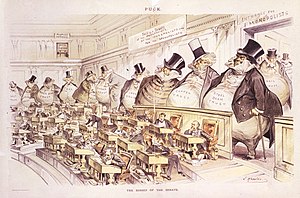
     Over the years many dominant companies have been humbled by antitrust lawsuits filed by the US Government (Microsoft, Standard Oil, etc.). With the the shut down of monopolies, industries have begun turning into oligopolies, which aren't necessarily any better.

Image result for antitrust

     An Oligopoly is defined as a state of limited competition, in which a market is shared by a small number of producers or sellers. So where do we see Oligopolies today?

   Right now some of the most prominent industries run by oligopolies are the Entertainment industry, the airline industry, the pharmaceutical industry, and the Oil and Gas industry. Now all of these industry are used everyday by all of us. Whether we are buying gas for our cars, or watching a TV show, people world wide are interacting with these Oligopolies on a daily basis.
  

Saturday, November 2, 2019

The FANGs

The FANGs, Facebook, Amazon, Netflix, and Google, are the four best performing tech stocks in the market. They have generated more than a considerable revenue for their investors, and are popular worldwide. Without them, technology is our world would be unimaginable.

To get a gist of just how big their stock prices are, we can look at data from the past few years. The S&P 500 index represents the U.S. market based on the market capitalization of the 500 largest stocks on NYSE and NASDAQ, both stock exchanges (New York Stock Exchange and National Association for Securities Dealers Automated Quotations respectively). Stock exchanges are marketplaces in which securities, stocks, commodities, and other financial products are sold. Stock exchanges allow buyers and sellers to trade efficiently.

Based on the NASDAQ, a couple years ago in 2017, Facebook was up 47%, Amazon 27%, Netflix 36%, and Google 16%. Their rankings in the S&P 500 index were 5th, 3rd, 31st, and 8th respectively. These high rankings tell us that the FANG stocks have a greater impact on the value of the index than any other company, which also means that these four companies have control over the overall market.
Image result for fang stocks YTD performance 2017

Many economists view this control negatively and express multiple concerns. One concern involves investors. Because so many of them are all investing in these four companies alone, the outcome is scary for them if FANG experiences a crash. In fact, crashing is one of the biggest things that economists worry about for FANG. This is because when you compare the situation of FANG to the dotcom stocks in the late 1990s, they appear similar with similar predicted progress and dotcom ended up crashing lasting from 2000 to 2004. Many also simply state that it is just not healthy to be having this much control over the market.

But the FANGS also have their own benefits and are all subtly different. They are enormously profitable and the products they sell are captivating and efficient for consumers and users. Furthermore, they can sell their products whenever they have internet access, and they don't have to worry about supply chain issues.

It is interesting to predict what the outcome will be for these four big companies. They're great now, but will they still be this great in the future?

Sources:

Friday, November 1, 2019

Eliminating Student Debt: A Saving Grace or an Economic Disaster?


With the democratic candidate elections coming up, many of the candidates have plans for student debt. Candidates such as Bernie Sanders and Elizabeth Warren want to let go of the over $1.5 trillion student debt loan that currently exists. Sanders wants to make plans to make college free, while Warren wants to impose a "billionaires tax" to help lighten the debt.

However, economists have predicted that this will simply act like a tax cut and lead to household consumption and investment. William Foster, a credit analyzer, also predicted that it would increase the national GDP by close to $100 billion over a 10 year period. (Which isn't much in a $21.5 trillion economy)

On the other side, there could also be some negative effects. "'It could also increase the risk of moral hazard and the accumulation of even higher student debt burdens."' Future borrowers, for instance, might be encouraged to run up big loan balances on the assumption that their debts will be forgiven at some point." Alongside this, it is determined that 2/3 of student debt is held by the top 1/2 of earners in the US.

Sources:
https://www.cnbc.com/2019/11/01/wiping-out-student-debt-would-be-small-boost-to-economy-moodys-says.html

T-Mobile and Sprint Merge

After over a year of waiting, the US Justice Department approved a $26 billion merger deal taking place between T-Mobile and Sprint after Dish reached an agreement with the carriers. Now, Dish is becoming the replacement fourth major carrier now that T-Mobile and Sprint have become one. Both T-Mobile and Sprint are required to provide at least 20,000 cell sites and hundreds of retail locations to Dish.

The reasoning for the merge between companies was that they believed combining their assets would make them a bigger competitor to AT&T and Verizon. Verizon and AT&T are much bigger than the other two companies, so this merge can potentially create more revenue and more competition. They also believed that their merge would allow lower prices for consumers and a faster spread for next-generation 5G networks around the country.

I believe that this merge is a smart economic idea for Sprint and T-Mobile because the companies are now able to combine the perks from both companies and make it one. They also claim that their plans will be lower than they previously were, so more consumers may switch to this new company from AT&T or Verizon.

https://www.theverge.com/2019/7/26/6646158/t-mobile-sprint-merger-justice-department-approves-26-billion-fcc
https://www.cnet.com/news/t-mobile-sprint-deal-wins-justice-department-ok-what-you-need-to-know/